Tuesday, July 6, 2010

Palestinian "Settlements"

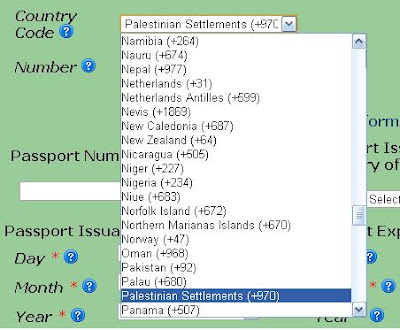
I'm planning on traveling to the US soon, and got pretty confused and thought I needed to fill out a form on the "Electronic System for Travel Authorization", which is an authorization for individuals holding foreign passports that can enter the US with no visa.


Ok...so in my confusion I was filling it out (I don't actually need to) and I had to enter my telephone number. LO AND BEHOLD- the area code for Palestine is under the label of "Palestinian Settlements"-- Umm..Ok I know the US government is often very-- one sided about this international, global, historical issue. But in no way- and I mean in no way are the Palestinian territories a "settlement." There are Israeli "settlements" on Palestinian territories. But there is no such thing as a "Palestinian Settlement"

Reading material: This document from the United Nations Office for the Coordination of Humanitarian Affairs

This is not a nomenclature debate- nor a tricky wording issue. This is wrong.

Monday, July 5, 2010

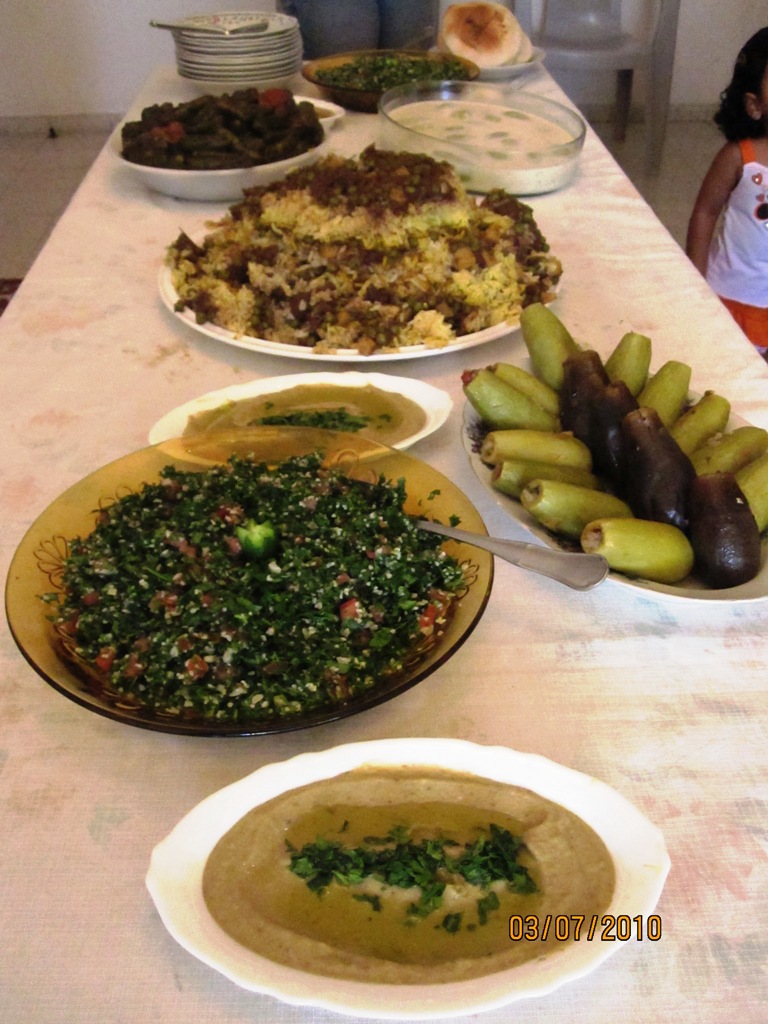
FEAST Gaza Style

My friend G cooked up a storm! It was absolutely, magically delicious!
Wara Einab- Stuffed Grape Leaves. They were DIVINE. So rich and tasty and so plentiful too.
Lotso of babaganoush, taboule, stuffed zucchini and eggplant too!

AMAZING!


Sunday, July 4, 2010

Count my lucky sunsets

Some count their lucky stars, I count the lucky sunsets I have the pleasure of seeing outside my bedroom window. I don't know if I'll ever have this view from my bed again.

deLIGHTful!

Saturday, July 3, 2010

When the building crumbles


After "Cast Lead," the war in Gaza ending in early 2009- buildings and home were left destroyed throughout the Gaza Strip. I went to visit one of the engineers from the United Nations Development Program (UNDP and he showed me some of the innovative materials that they were trying to make now that half of Gaza was left in crumbles. The rubble removal project lasted over a year after the war, and there are still many buildings that are yet to be completely demolished.


Here's the problem-- the rubble was removed- step 1, but nothing else is happening. There is barely any reconstruction happening becuase no materials are allowed into the Gaza strip to enable actual reconstruction. Lately there has been some wood allowed in- and a very small amount of cement under very controlled means- through the United Nations. Certainly not enough to even start making a dent.


UNDP is left with hundreds of tons of rubble, and ideas sparked in terms of what could be done with the carcasses of destroyed houses. The engineer showed me one of the little ideas they had which was using it as the filler for this cactus plant, below:
But the bigger and better idea is to make these sort of cinder blocks out of rubble. The only problem-- it needs a lot of cement. Enough was allowed in to re-pave one road- it looks great, but it seems to be at a standstill at this point.

"Just add spices"


Ok, my eternal issue in Gaza is that conversations about food usually go like this:
Me: Oh my gosh, this food is DIVINE, this is the most delicious thing I've ever tasted. HOW did you make this?
Palestinian woman: Oh it's SO easy.
Me: How? What did you put in it??
Palestinian woman: Chicken, rice
Me: AND?
Palestinian woman: And spices
Me: What spices?
Palestinian woman: Chicken spices
Or "maklouba spices" or "fish spices" or "maftoule spices"-- Maftoule is CousCous in Palestine. Usually my response is "but, but, how do I get the Maftoule spices"--the answer is "go to the spice shop and just tell the guy you want Maftoule spices"-- I then have to explain, look once I leave here-- there isn't going to be a spice man!
It's usually a nightmare trying to figure out what the heck these magical mixes have in them. My friend Dawne even joked about taking them to a laboratory and getting the spices identified. It's not a far-fetched idea.

This pattern happened again when I went to get some roasted chicken, this chicken is from Jerjawi, the best chicken place in town. These succulent chickens are stuffed with divine rice covered in "spices"- they also put lots of lemons on top of it and a final magic 'spice'--
I asked everyone, what's this spice, WHAT is this spice? "Chicken spice" everyone responded.


Living Vicariously Through Others

My movement restrictions these days impede me from prancing around Gaza, but others can- so I'm living vicariously through them. I claim no credit to the lovely pictures below taken by my friend Patricia. Today they went on an exciting tour of Gaza, on the hunt for mosaics, roman ruins and other goodies.

The romans pretty much made their mark as far as they possible could, and Gaza wasn't left out. Unfortunately, due to bigger priorities-- Gaza's ruins and antiques aren't protected under glass and kept in perfect temperatures, but there are still a few items left preserved.
Below, the image of the tomb (or the monsatery- not clear) of Saint Hilarion. He was born south of Gaza and spent most of his life as an anchorite (withdraws from secular society for prayer). After reading a bit more about St. Hilarion-- I do wish I could go and visit this place myself!
St. Hilarion was "beset by carnal thoughts"- hence decided to go on a wild diet that sounds excruciating- no wonder he started seeing deamons. He kept a close diary of his diet which included:

"from 20-23: half a pint of lentils moistened with cold water
23-27: dry bread with salt and water
27-30: wild herbs and roots
31-35: six ounces of barley bread, and boiled vegetables without oil
After that, he suffered from signs of malnutrition, his eyesight grew poor, his body shrivelled and he developed dry mange and scabs, so he had to slightly modify his diet.
35-63: six ounces of barley bread, and boiled vegetables with oil
63-80: six ounces of water, boiled vegetables with oil and a broth made from flour and crushed herbs, taken after sunset"
A baptismal bath?
The gatekeeper, a 90 year old sweet woman who carries the key to this magical place.


Gaza's warm climate is bringing up beautiful bright flowers as others die due to lack of water.

Last but not least the fabulous Byzantine mosaic still preserved. It is kept covered with a clot and sand over it to reduce the damage, though you can see the little mosaic pieces falling off in the corners. Some interesting details at this link.


Wednesday, June 2, 2010